

What a spider identifier can do
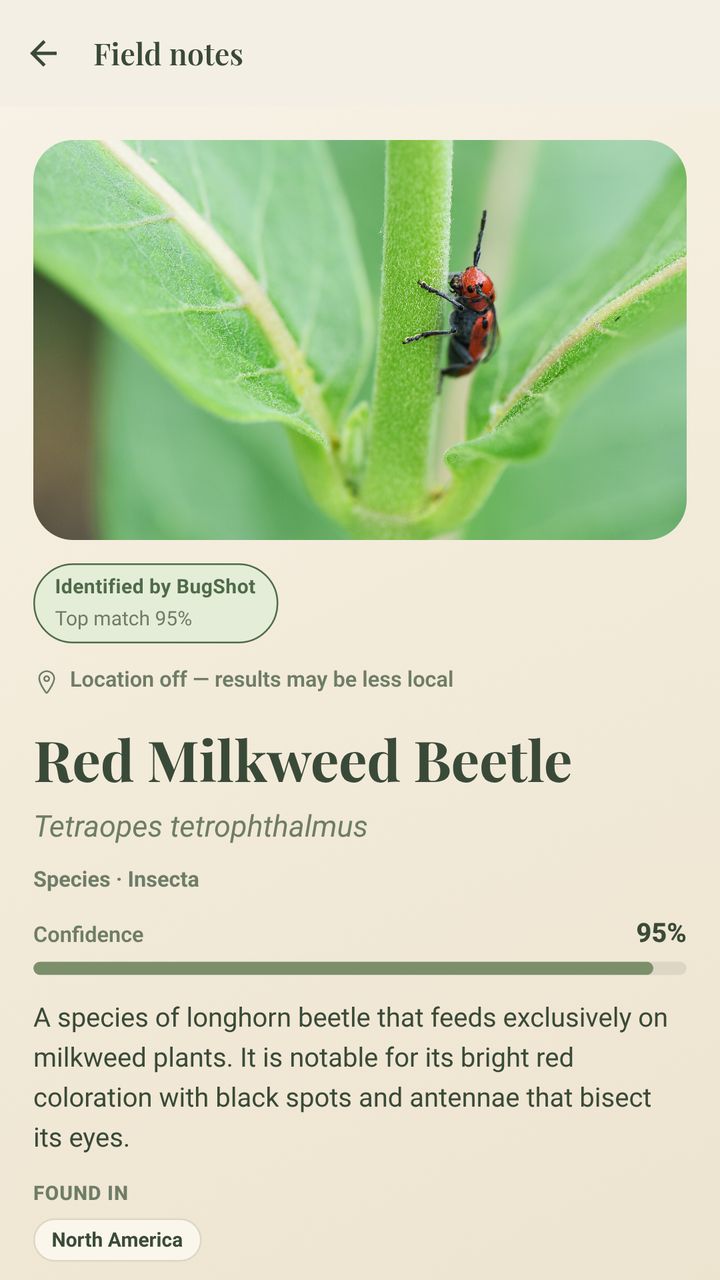
A spider identifier helps you get a likely name for a spider you have found, based on a photograph. With BugShot, you take a picture or choose one from your library, and the app returns a likely identification, a confidence level, and a short description. That can be enough to calm a worry, or to suggest that you should give the spider more space and get help removing it.
Spiders found in and around U.S. homes are often harmless to people. A few species can give medically significant bites, and many harmless spiders are mistaken for them. That is one reason a careful photo, and cautious wording, matter. BugShot describes its result as a likely identification. It is not a medical diagnosis and it cannot tell you, by itself, what will happen if someone is bitten.
You do not need an account to use BugShot, and the app has no ads. Location is optional. If you allow it, identifications can favor species known from your area, which is especially relevant for spiders whose ranges are limited.
How to photograph a spider safely
Photograph from a comfortable distance first. Many spiders can be identified, at least to a likely group, from a reasonably close picture without touching them or trapping them in a jar. If you cannot get a clear shot without reaching into a corner or putting your hand near the spider, step back. A slightly distant photo is better than a close one that puts you at risk.
What to include in the frame
Try to show the whole spider: the cephalothorax (the front body section), the abdomen, and the legs. From above, you can often see the overall pattern and leg span. A side view can show body shape and whether the abdomen is rounded, elongated, or marked in a distinctive way. If the spider is on a web, including a bit of the web can help, because some common house spiders and cellar spiders are as recognizable from habit as from color.
Focus on the spider, not the wall behind it. Use even light if you can. A direct flash may glare or throw harsh shadows. If the spider is in a dark garage or basement, add light from the side rather than leaning in with the phone close to the animal.
Scale and a second photo
Size helps tell a wolf spider from a much smaller house spider, or a large fishing spider from something else. If you can include a nearby object for scale without putting your hand next to the spider, do so. Take a second photo if the first is blurry. Do not try to pick the spider up, even with paper, if you think it might be a widow, a recluse, or another species of concern, or if you simply do not want to risk a bite.
Spiders people often find in U.S. homes
Common household spiders in the United States include several groups people photograph again and again. Local fauna varies, and common names are used loosely, so treat the notes below as general orientation rather than a field key.
Frequent indoor and garage spiders
Common house spiders and related cobweb spiders often sit in messy webs in corners, closets, basements, and garages. Cellar spiders, sometimes called daddy longlegs spiders, have very long, thin legs and usually hang in loose webs in basements, crawl spaces, or ceilings; they are different from harvestmen, which are also called daddy longlegs but are not spiders in the same way and do not build those webs. Jumping spiders are compact, often boldly patterned, and may be seen hunting on windowsills or sunny walls rather than sitting in a large web.
Wolf spiders are typically robust, hairy, and fast-moving, and are often found at floor level or coming in from outdoors. They do not usually sit in a snare web the way house spiders do. Grass spiders (funnel weavers) are sometimes confused with wolf spiders; they often have long spinnerets and are associated with a sheet or funnel web in grass, gardens, or corners of buildings.
Orb weavers are more often noticed outdoors, on wheel-shaped webs on porches and in shrubs, but people do photograph them at doors and windows. Many are harmless to people and are easier to identify when the web and the dorsal pattern are both visible.
Species of concern, and how often they are misidentified
Two groups cause a disproportionate amount of worry in the United States: widow spiders and recluse spiders. Both deserve caution, and both are also blamed for many spiders that are not them.
Black widows and other widow spiders are often recognized by a typically glossy, rounded abdomen and, in many adult females, a red marking on the underside of the abdomen. They are associated with sheltered, often cluttered spaces such as woodpiles, sheds, and meter boxes. Not every dark spider is a widow, and not every red mark on a spider means it is one. A clear photo of the abdomen, including the underside if you can get it without touching the spider, is more useful than a guess from color alone.
Brown recluse spiders have a more limited range, mainly in parts of the south-central United States, though people far outside that range often wonder whether they have one. Recluses are typically uniformly brown, with a violin-shaped mark on the front body section in many individuals, long thin legs, and a characteristic eye arrangement that is difficult to see in casual photos. Many common brown spiders — including wolf spiders, grass spiders, and some cellar or crevice spiders — are mistaken for recluses. A likely identification from a photo can be helpful, but it is also a good example of why confidence may be lower and why “likely” is the right word.
In parts of the southern and southwestern United States, people also photograph scorpions around homes. Scorpions are not spiders, but they turn up in the same household searches. Give them space, and do not try to handle them for a photograph.
Look-alikes
- Wolf spider versus grass spider versus brown recluse: overall bulk, leg thickness, spinnerets, web (or lack of one), and geographic range all matter. A top-down photo that includes the legs and front body is a start; these are still easy to confuse.
- Cellar spider versus harvestman (“daddy longlegs”): a cellar spider has a clearly divided body and is usually on a web; a harvestman appears more compact, without a narrow waist, and is not on a cobweb.
- Common house or cobweb spiders versus widows: web type, abdomen shape, and underside markings help; many cobweb spiders are not widows.
- Large, dark garden spiders versus something dangerous: many striking orb weavers worry people because of their size and pattern, but size alone is not a sign of a medically significant bite.
Confidence, range, and the word “likely”
BugShot shows a likely identification and a confidence level. Spiders are a group where that wording is particularly important. Pattern, size, and location in the house can suggest a match, but similar species are common, and some of the most worrying identifications are also the ones most often applied in error.
If you allow optional location, the app can favor species that occur in your region. That can reduce some kinds of mix-ups, for example when a species of concern is not generally found where you are. It still does not make a result certain. Spiders can be moved in belongings, and range maps are not perfect. If confidence is modest, or several candidates are listed, treat the result as a short list to compare, not as a final name.
A second photo, better light, or a slightly closer frame taken safely can change how clear the result is. If an identification would affect medical decisions or how you treat your home, get help from a qualified professional rather than relying on the app alone.
Safety: bites, emergencies, and when to get help
Most spider encounters in homes do not end in a serious bite. Still, any bite can be painful or become infected, and a few spiders can cause more significant illness. BugShot cannot rule a medical risk in or out, and it should not delay care.
Seek emergency medical care immediately if someone has trouble breathing, swelling of the face or throat, dizziness, fainting, or other severe symptoms after a bite. In the United States, call Poison Control at 1-800-222-1222 for advice about a suspected venomous bite. If a child is bitten, or if you think a widow or recluse may be involved, get medical advice promptly even if symptoms still seem mild, and follow the clinician’s instructions rather than an app result.
If you need a spider removed from a bedroom, a child’s room, or a high-traffic area and you are not comfortable doing it from a safe distance, consider professional pest or wildlife help. Keep people and pets away from the area in the meantime. Do not crush a spider with your hand or a bare shoe if you believe it may be a species of concern; you can lose the chance to photograph it and you increase the chance of a bite.
For repeated sightings or a large number of spiders in a building, a licensed pest professional can inspect harborage areas. A likely identification from a photo may help you describe what you are seeing. It is not the same as a site inspection.
Privacy and pricing
BugShot is made by United Ora Inc. The spider identifier is the same app as the insect identifier: free to download, with free identifications every day, no account, and no ads. BugShot Pro is optional if you want up to 400 identifications a week. Subscriptions are purchased in the App Store or Google Play. A shareable install link is at unitedora.com/get.
Photos you identify are sent over HTTPS. Location is optional and not stored. History is kept on your device. Read the BugShot Privacy Policy for details and for how to request deletion of records.